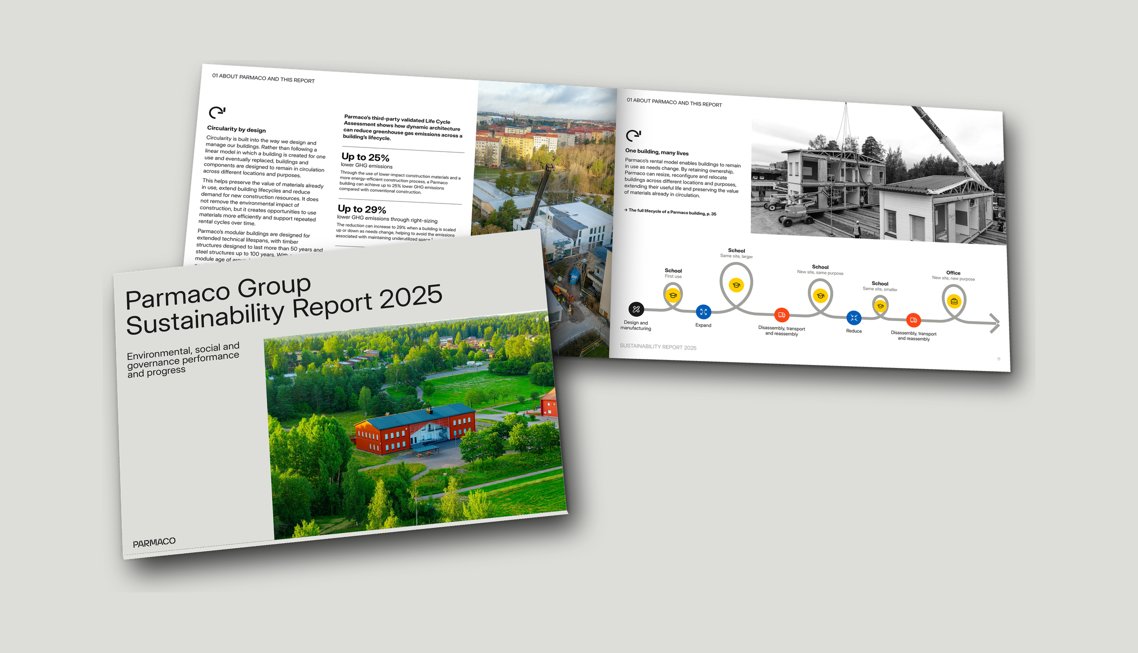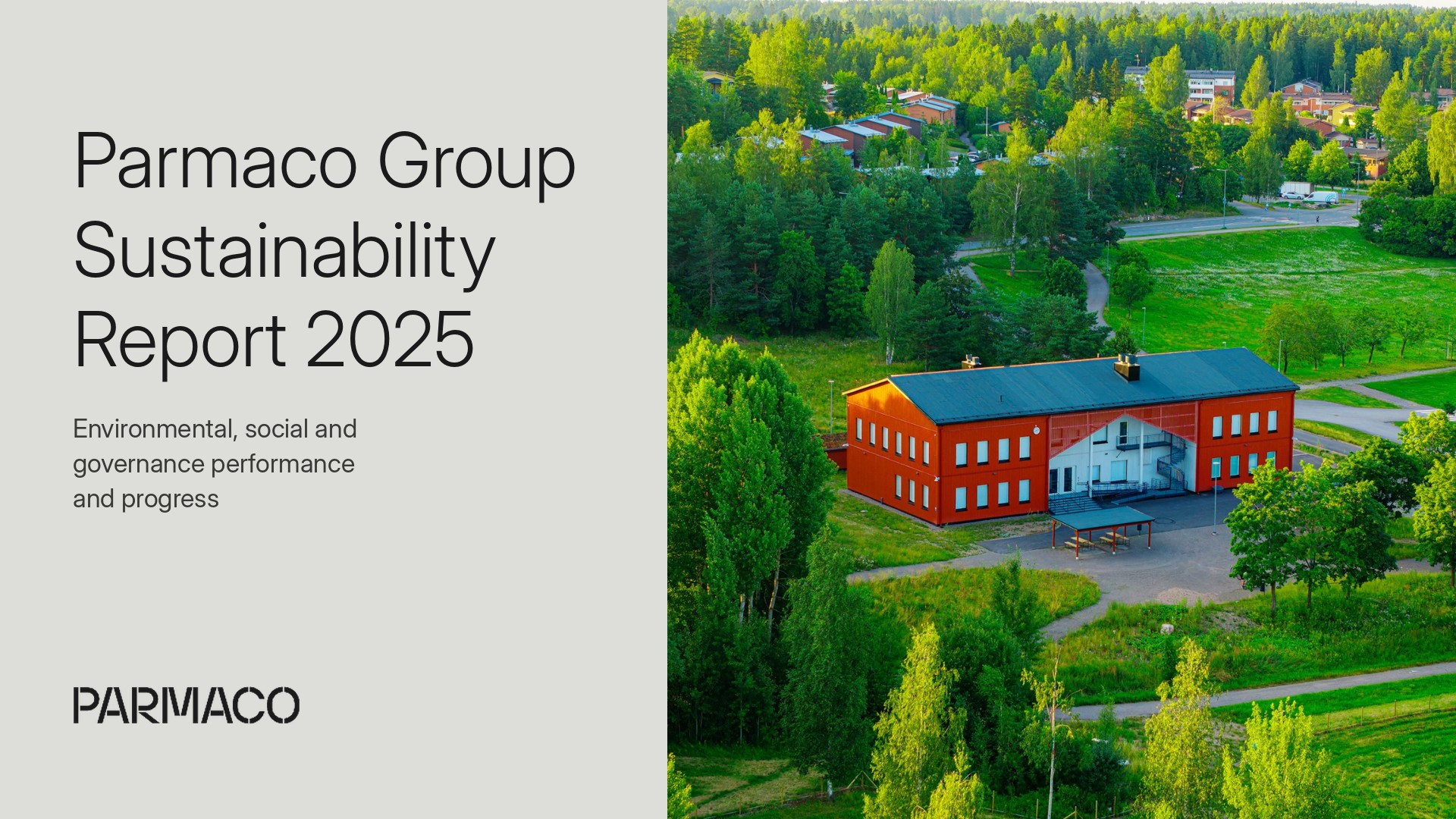
Parmaco publishes first Group Sustainability Report, demonstrating circularity at scale
The report highlights Parmaco’s 2025 sustainability performance and how its circular business model keeps high-quality buildings in use across different customers, locations and purposes.
Parmaco Group today publishes its first Group Sustainability Report, presenting its environmental and social performance across Finland, Sweden, Denmark and Germany in 2025. The report brings together key sustainability results, business performance indicators and priorities for the years ahead.
Parmaco designs, builds, owns and rents high-quality buildings that can be reconfigured, relocated and reused as needs change. Unlike conventional construction, where buildings are typically tied to a fixed purpose and location, this approach allows existing resources to serve new customers and applications over time.
Sustainability is embedded in how we design, own and manage our buildings. By retaining ownership, we take responsibility for keeping them in use beyond their original purpose. Our first Group Sustainability Report presents our sustainability performance and sets out the priorities that will guide our work going forward, says Jukka Joutsenkoski, CEO of Parmaco Group.
A business model built around circularity
Parmaco’s rental model is designed to keep building resources in use across successive customers and applications. When requirements change, buildings can be reconfigured, relocated or repurposed, with Parmaco retaining responsibility for their next use.
The Group manages more than 400 dynamic rental buildings with approximately 366,000 m² of rented floor area. More than 90% of revenue comes from rental operations, and 93% of rented floor area is covered by mid- to long-term contracts. Total fleet time utilisation reached 85% in 2025.
The report highlights circularity in practice. In Vantaa, Finland, a former school from Tuusula was relocated and transformed into offices for Valmet, reusing 89% of its modules. In Helsinki, Pihkapuisto Primary School and Kaunokki Daycare share a 4,300 m² facility incorporating more than 90% reused modules from three previous buildings.
2025 sustainability performance and priorities
The report also presents measurable progress in Parmaco’s environmental performance and outlines the Group’s sustainability priorities for the years ahead.
In 2025, 97% of electricity consumed by the Group came from renewable sources, compared with 66% in 2024. Scope 1 and 2 greenhouse gas emissions per square metre of total fleet decreased by 49% year on year.
In the end-user survey, 95% of respondents reported satisfaction with Parmaco buildings, reflecting the importance of quality and user experience alongside environmental performance.
The report provides a consolidated view of the Group’s climate footprint, including emissions from purchased materials and services, which account for the majority of its total emissions.
While we have made significant progress in our own operations, our greatest opportunity to reduce emissions lies across the wider value chain. Our climate and transformation roadmap to 2034 sets the direction for this work, with a continued focus on reducing emissions, improving resource efficiency and strengthening our circular business model, says Joutsenkoski.
The report has been prepared with reference to the Voluntary Sustainability Reporting Standard for non-listed SMEs (VSME).
DOWNLOAD THE REPORT /
Parmaco Group Sustainability Report 2025
PDF · 15 MB · 54 pages · English